

When developing analytical methods for New Molecular Entities (NMEs) or complex specialty chemicals, relying solely on UV detection can often feel like navigating without a map. If a peak shifts due to a mobile phase adjustment or an unexpected impurity appears, simple retention time comparison is rarely enough to provide definitive answers.
The Power of Nominal Mass Verification
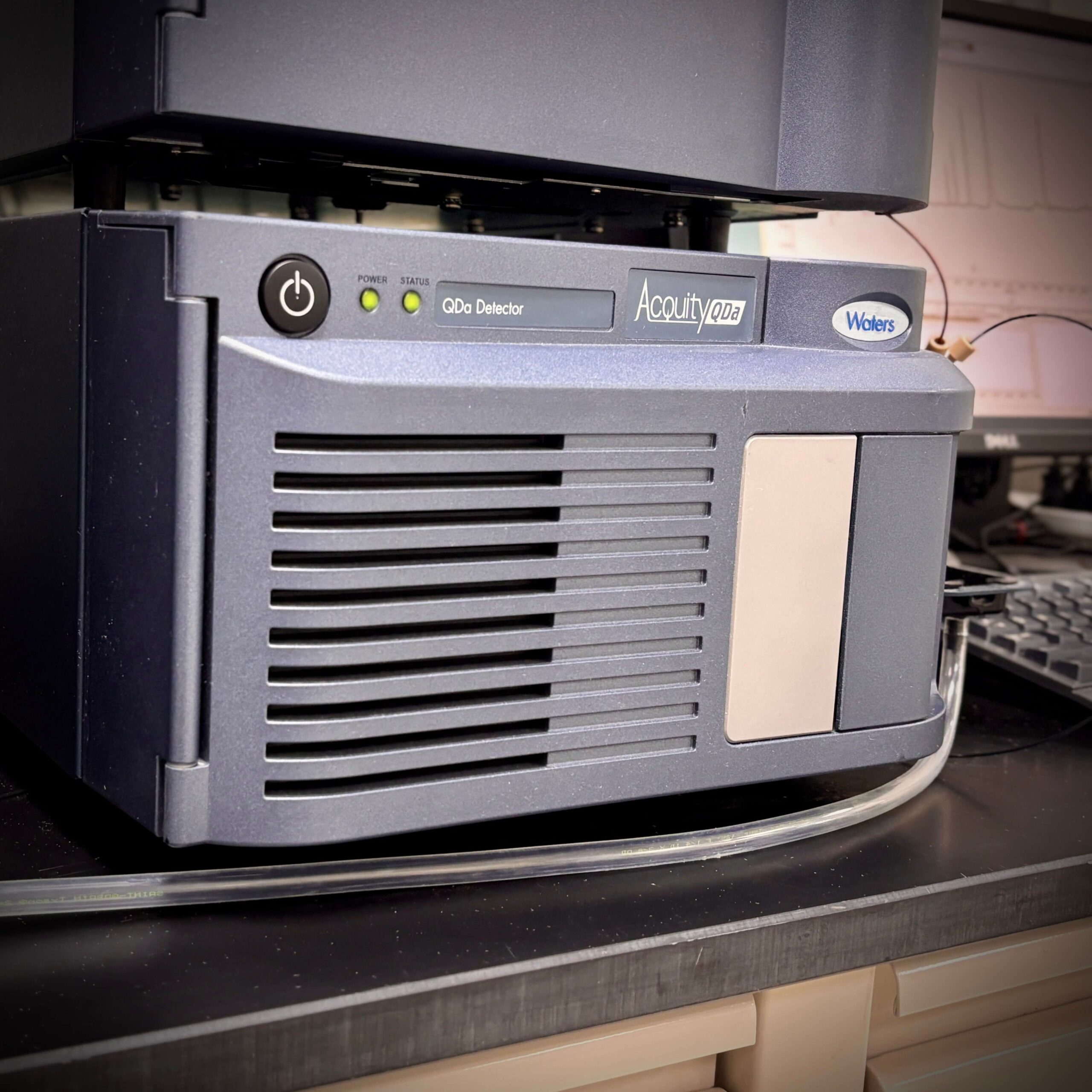
At Scout Scientific, we elevate our chromatographic analysis by incorporating mass directed detection via the Waters QDa mass detector. By placing this technology directly in line with our HPLC systems, we move beyond the ambiguity of traditional UV characterization. This allows us to provide nominal mass verification for every significant peak, ensuring that the molecule you are tracking is the molecule you are actually measuring.
Real Time Peak Tracking
The primary advantage of our LC MS capability is the ability to perform “peak tracking” during the method scouting and optimization phases.
- Dynamic Optimization: When we shift mobile phase pH or gradient slopes, the QDa allows us to track the mass of the analyte of interest even as retention times shift significantly.
- Impurity Identification: We can rapidly determine the mass of unknown degradants during forced degradation studies, providing immediate insights into molecular stability.
- Resolving Coelution: Mass data allows us to identify and resolve overlapping peaks that UV detection alone might miss, preventing major technical hurdles later in the development cycle.
Integrated Scientific Interpretation
At Scout Scientific, we do not just provide a raw data dump from a standalone mass spec system. Because our LC-MS workflow is fully integrated into the Waters Empower 3 environment, your mass spectral data is captured and processed alongside your HPLC results.
Our Principal Scientist provides active interpretive support for these results, helping to correlate mass data with chromatographic behavior to drive informed decisions. This senior led oversight ensures that your mass insights are applied directly to the broader analytical context of your project, providing the technical certainty required for critical CMC and R&D decision making.